AI for WooCommerce in 2026: Tools, Use Cases, and Best Practices
A guide to using AI in WooCommerce in 2026, covering product content, chatbots, search improvements, personalization, and automation.
AI for WooCommerce no longer just means chatbots or other automations. In 2026, store owners employ AI to revise product pages, engage with customers, analyze shopping behavior, and streamline time-consuming e-commerce processes.
The greatest improvement has been in accessibility. Companies don’t have to worry about allocating huge portions of their budgets to see which AI tools will be useful for them. Many of the tools are now available through WooCommerce plugins and other integrations that work with their existing store.
Here’s a guide to the most helpful AI categories for WooCommerce in 2026. These tools can save store owners a lot of time. If you want a complete look at AI tools for WordPress, be sure to check out our guide on creating AI-powered WooCommerce stores.
How AI in WooCommerce Has Changed Since 2021
In 2021, the majority of WooCommerce AI applications consisted of straightforward suggestions, chatbots governed by rules, and basic automation. These applications relied on a large set of rules and a small amount of customer data.
By 2026, AI applications have integrated better with ecommerce systems and offer store owners the ability to create product descriptions, streamline product discovery, automate conversations with customers, interpret sales trends, and design tailored shopping journeys, all without having to program the system from the ground up.
Beyond improvements in technology, the biggest change has been accessibility. Features that once required custom development can now be implemented through plugins and third-party integrations.
The Six AI WooCommerce Categories: Overview
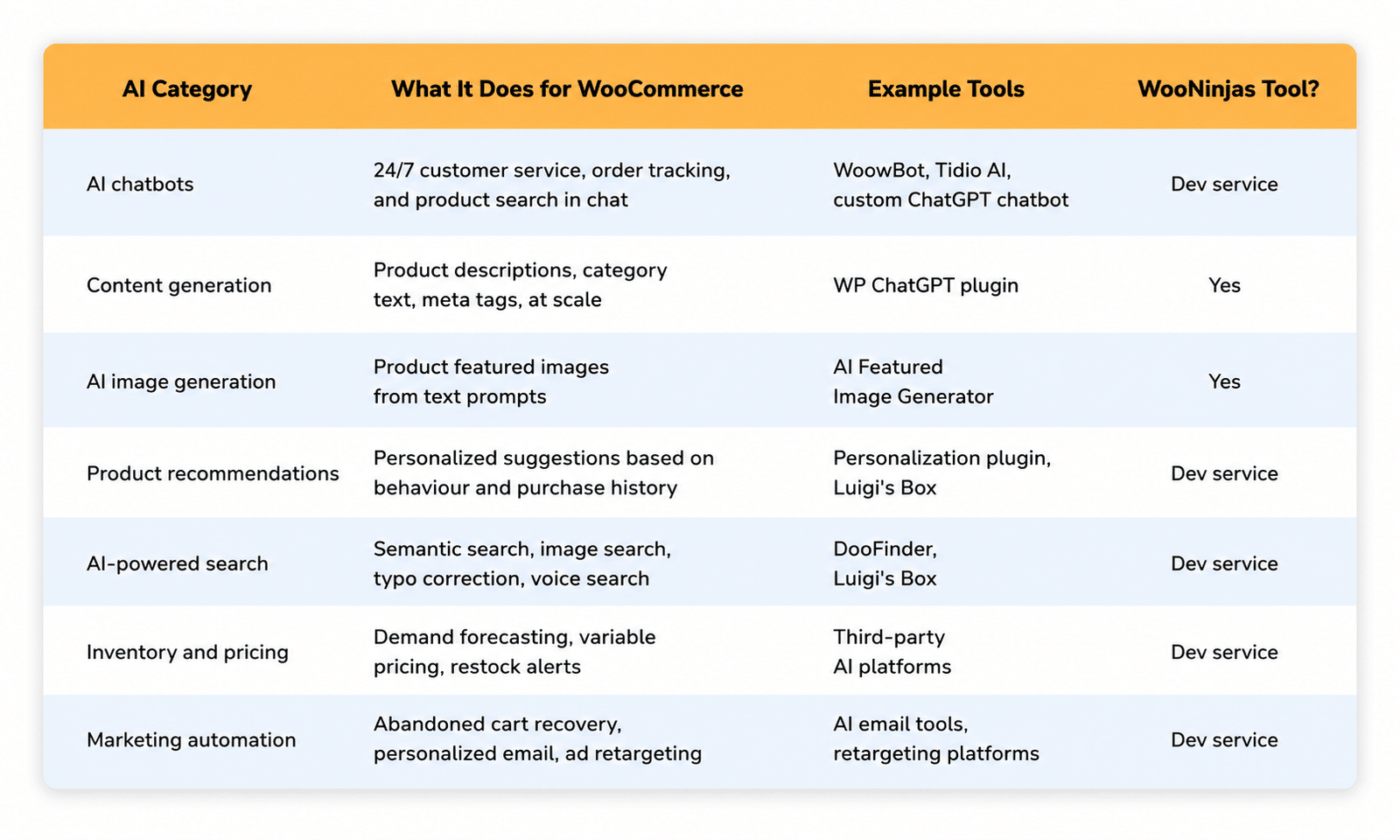
The table below maps the main AI WooCommerce application areas to their function and the tools available for each. WooNinjas has first-party plugins in the content generation category. The other categories are served by third-party plugins and, for stores with specific requirements, custom development by the WooNinjas team.
1. AI Chatbots for WooCommerce Customer Service
An AI chatbot is the most visible AI WooCommerce application for customers. A well-configured chatbot handles the questions that take up the most customer service time: where is my order, what is your return policy, do you have this product in a different size or colour, and can you recommend something based on what I am looking for?
The difference between a 2021-era WooCommerce chatbot and a 2026 one is significant. The older generation required you to manually write response scripts for every possible question. Modern AI chatbots are trained on your product catalog and can answer questions they were never explicitly programmed to answer, because they understand context and intent rather than matching keywords to scripts.
WoowBot: WooCommerce-native AI chatbot
WoowBot is built specifically for WooCommerce and integrates directly with your store’s product catalog, cart, and order data. Customers can search for products, add items to their cart, and check their order status from within the chat window. It runs on DialogFlow or OpenAI, meaning the underlying language model can handle natural language queries rather than just keyword matching. On-site retargeting is also built in: WoowBot can detect when a visitor is about to leave and trigger a targeted message to re-engage them.
Tidio AI for WooCommerce
Tidio is a broader customer service platform that includes an AI chatbot with WooCommerce-specific features. It accesses your product catalog to provide accurate stock, pricing, and delivery information in real time. It handles frequently asked questions automatically, escalates complex issues to a human agent when needed, and tracks the conversion statistics for chatbot interactions so you can see which conversations result in purchases.
Custom ChatGPT chatbots for WooCommerce
For stores with specific requirements, a custom ChatGPT-powered chatbot can be built to match your exact product catalog structure, your support workflows, and your brand voice. WooNinjas builds custom AI WooCommerce chatbot solutions for stores that need more than standard plugins can provide. For more on what is possible with ChatGPT and WooCommerce, see the WooNinjas guide to using ChatGPT with WooCommerce.
2. AI-Generated Product Content
Writing product descriptions is one of the most time-consuming tasks in WooCommerce store management, and one of the most commonly skipped. A store with hundreds or thousands of products often has thin, copied, or missing product descriptions because writing unique copy for each product is simply not feasible without dedicated copywriting staff.
AI content generation solves this problem directly. Instead of writing product descriptions manually, a store owner inputs the product title and key specifications, and the AI generates a complete, well-written description in seconds. Many stores also use additional Woocommerce extensions to connect these workflows with the rest of their ecommerce setup.
WooNinjas WP ChatGPT plugin
The WooNinjas WP ChatGPT plugin adds an AI content generator directly inside the WordPress editor. On a WooCommerce product page, you can enter the product title and any requirements, click generate, and receive a full product description written by GPT-4o, GPT-4 Turbo, GPT-4, or GPT-3.5 Turbo, whichever model you have configured. The generated content appears in the editor for review and editing before publishing.
The WooNinjas WP ChatGPT plugin adds an AI content generator directly within the WordPress editor. On a WooCommerce product page, you can enter the product title and any requirements, click Generate, and get a complete product description written by GPT-4o, GPT-4 Turbo, GPT-4, & GPT-5, depending on the model you have set up. OpenAI’s API platform provides these models, allowing developers and applications to include AI features in their workflows. The generated content shows up in the editor for you to review and edit before publishing.
This workflow removes the blank-page problem entirely. Instead of writing from scratch, you are editing and refining AI output, which is significantly faster. For stores with large product catalogs that currently have thin or missing descriptions, this plugin can address the problem at a scale that would otherwise require weeks of copywriting time.
- Compatible with both Gutenberg and Classic Editor
- Works on WooCommerce product pages, blog posts, course pages, and any custom post type
- Supports the latest OpenAI models, including GPT-4o
- Last updated 10 March 2026
- Priced from $69/year for a single site
WooNinjas AI Featured Image Generator
The WooNinjas AI Featured Image Generator handles the visual side of product content. Type a text description of the image you need, the product, the setting, and the style, and the plugin generates a unique image. A built-in drag-and-drop editor lets you add layers, text, and branding elements before saving it to your media library and setting it as the product’s featured image. For WooCommerce stores that need product visuals for new items or missing images, this removes the need for external design tools or stock photography.

| WooNinjas builds custom AI solutions for WooCommerce and has the tools to get you started today. If your WooCommerce store needs a custom AI WooCommerce chatbot, a personalization engine, or a bespoke AI-powered workflow that off-the-shelf plugins cannot cover, the WooNinjas WooCommerce customization team builds it. For store owners who want to start with a ready-to-use tool, the WooNinjas WP ChatGPT plugin generates product descriptions and store content directly from the WordPress editor, with no custom development required. |
3. AI Product Recommendations and Personalisation
Generic product recommendation blocks, the ‘Customers also bought’ and ‘Related products’ sections that WooCommerce shows by default, are based on simple category matching or purchase co-occurrence. AI-powered personalization goes further by building an individual profile for each visitor based on their browsing history, search behavior, time on page, and purchase history, then serving product suggestions that reflect that specific profile.
Personalisation WooCommerce plugin
This plugin segments your visitors in real time, building micro-segments based on behavior signals and serving each segment a different product experience. If a product is out of stock, it also identifies the best alternatives for each visitor rather than showing a generic ‘out of stock’ message. The result is a product catalog that adapts to each visitor rather than presenting the same static grid to everyone.
Luigi’s Box
Luigi’s Box combines AI-powered search with a product recommendation engine. It corrects typos in search queries, autocompletes searches, and shows alternatives based on search keywords. Its product recommender surfaces suggestions based on the visitor’s search history, product views, and items already in their cart. Product listing pages can also be personalized based on the visitor’s interaction history, meaning a returning customer sees a different product order than a first-time visitor.
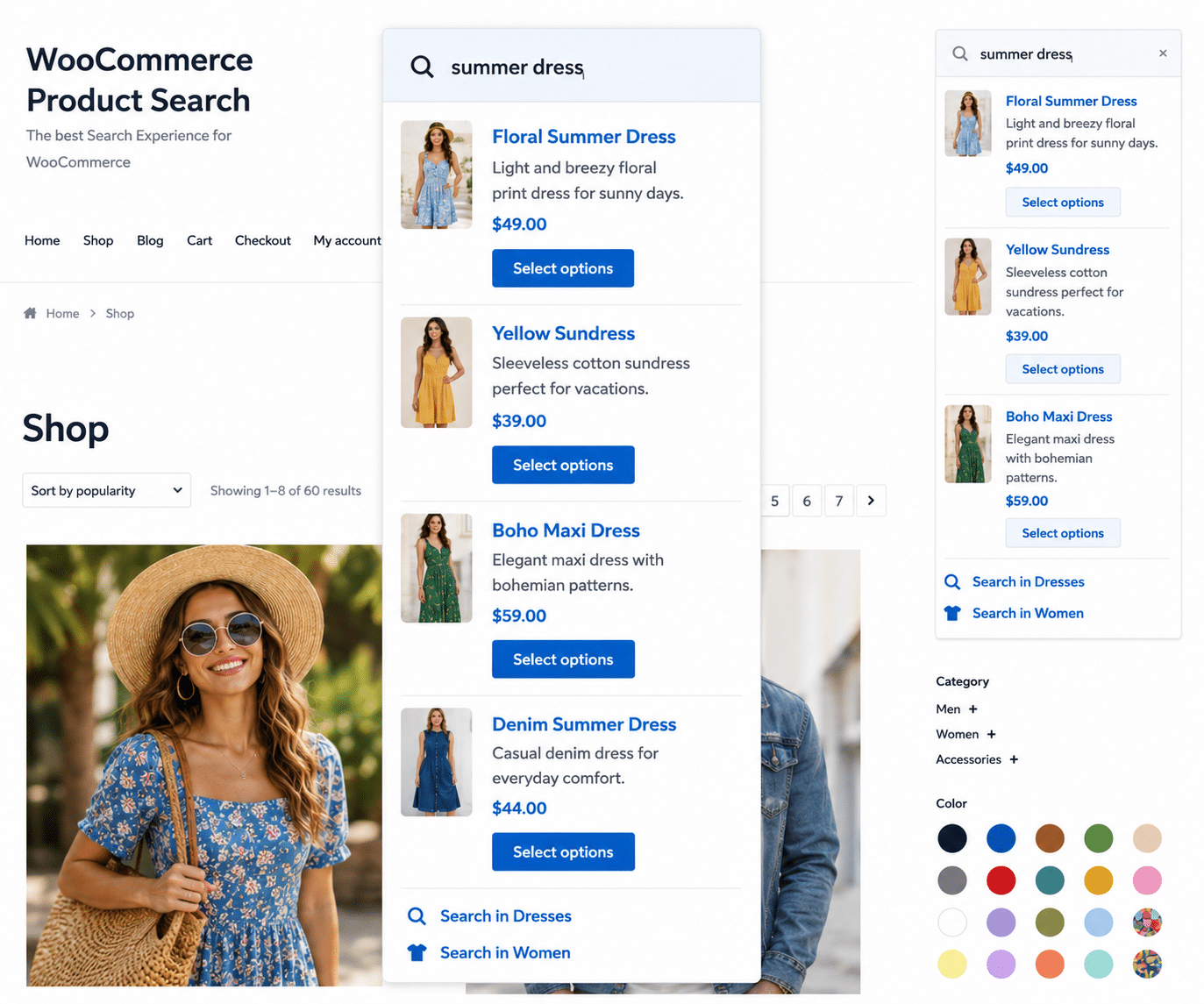
4. AI-Powered WooCommerce Search
Standard WooCommerce search matches keywords against product titles and descriptions. A visitor who searches for ‘lightweight running trainers’ will only find products that contain those exact words. AI-powered search understands intent: it recognizes that ‘trainers,’ ‘sneakers,’ and ‘running shoes’ refer to the same category, corrects typos, interprets natural language queries, and returns results based on what the customer means rather than what they typed.
Semantic and natural language search
Modern AI search for WooCommerce interprets queries in the way a knowledgeable sales assistant would. A customer who types ‘something warm for a January wedding’ receives relevant results even if no product description contains those exact words. The AI maps the query to product attributes: formal wear, warm fabrics, and suitability for winter. This type of search significantly reduces zero-result searches and the abandonment that follows them.
Looking for a Ready-Made Solution?
Explore our WordPress, WooCommerce, and LMS plugins built to extend functionality without custom development.
Image and voice search
Some AI search tools for WooCommerce, including DooFinfer, support image-based search, where customers can upload a photo of a product they are looking for and receive matching items from your catalog. Voice search, where customers speak a query rather than typing it, is increasingly common on mobile and is handled by the same natural language processing layer. Both input methods reach customers who find text search less convenient and would otherwise leave the store without purchasing.
AI Search and Customer Intent in WooCommerce
Traditional e-commerce search depends on matching keywords. Customers often do not search using the exact words used in product titles, which can lead to poor results and lost sales.
Modern AI search tools focus on understanding customer intent. A shopper searching for “comfortable shoes for long walks” may receive relevant products even if those exact words are not included in the product name.
For WooCommerce stores, improving search accuracy can directly improve product discovery, reduce failed searches, and help customers find products faster.
5. AI Inventory Management and variable pricing
Predictive inventory management
AI inventory tools analyze your historical sales data, seasonal patterns, and external factors to forecast demand. Rather than reordering stock based on a fixed minimum quantity threshold, an AI system adjusts reorder points based on predicted demand for the coming weeks. This reduces overstocking on slow lines and prevents stockouts on fast-moving products during peak periods. For WooCommerce stores with variable demand, especially those running seasonal promotions or flash sales, this prediction layer can reduce both dead stock costs and lost sales from stockouts.
Variable pricing
Variable pricing uses AI to adjust product prices based on demand signals, competitor pricing, time of day, inventory levels, and customer segment. A WooCommerce store running variable pricing can automatically increase prices when a product is nearly out of stock, offer personalized discount levels based on a customer’s purchase history, or match competitor pricing on key lines without manual intervention. This is more commonly used on larger stores with significant catalogs, but the tools for implementing it on WooCommerce are now accessible.
6. AI Marketing Automation for WooCommerce
Abandoned Cart Recovery
Abandoned carts are the most expensive leakage point in most WooCommerce stores. AI-powered abandoned cart recovery improves on the standard timed email sequence by analyzing the individual customer’s behavior: their purchase history, the specific products left in the cart, their engagement with previous emails, and the time of day they are most likely to open messages. The result is personalized recovery messages sent at the right time with the right content for each customer, rather than the same sequence sent to everyone who leaves without purchasing.
Personalised Email Marketing
AI email tools segment your customer list dynamically based on purchase behavior, browsing history, and predicted lifetime value, then generate personalised email content for each segment. A customer who bought running shoes three months ago receives a different email from a customer who last bought kitchen equipment. Both emails are generated and sent automatically based on the AI’s understanding of what each customer is most likely to respond to.
Ad retargeting and Audience Building
AI retargeting platforms analyze which visitors are most likely to convert on a second visit and build custom audience segments for ad platforms. Rather than retargeting everyone who visited a product page, the AI targets the subset of visitors whose behaviour signals indicate purchase intent, reducing wasted ad spend and improving return on advertising.
| PRO TIP: Start your AI WooCommerce work with product content generation, not chatbots. It requires the least setup, produces measurable results immediately, and does not require training or ongoing configuration. Install the WP ChatGPT plugin, connect your OpenAI API key, and generate product descriptions for your twenty worst-written product pages first. The time saving is immediate, and the quality improvement is visible. Once you have experienced what AI content generation can do for your catalog, the case for exploring chatbots and personalization becomes much easier to make internally. |
Benefits of Using AI in WooCommerce
AI tools can help WooCommerce stores improve efficiency in several areas:
- Faster product content creation for large catalogs
- Better customer support through automated responses
- Improved product discovery through smarter search
- More personalized shopping experiences
- Better decision-making through sales and inventory analysis
The value of AI depends on selecting tools that address specific store problems instead of just adding automation without a clear purpose.
Where to Start With AI WooCommerce
The easiest entry point into AI WooCommerce is product content generation, because it requires no customer-facing configuration and produces measurable results immediately. Install the WP ChatGPT plugin, connect your OpenAI API key, and generate descriptions for your worst-documented product pages first. Once the content workflow is working, add the AI Featured Image Generator to handle product visuals for the same pages.
As stores add more advanced workflows, they may also need changes to their store setup, integrations, or existing functionality. WoowBot is the most WooCommerce-native option and connects directly to your product catalog, cart, and order data. Tidio is worth considering if you need a broader customer service platform that handles both AI automation and human agent handoffs.
For personalization, AI-powered search, inventory management, and variable pricing, the right tool depends on your store’s catalog size, traffic volume, and technical confidence. These categories benefit from a conversation about your specific setup rather than a generic plugin recommendation. The WooNinjas WooCommerce customization team can advise on what is appropriate for your store and build custom AI WooCommerce solutions where off-the-shelf plugins fall short.
Things to Consider Before Adding AI to WooCommerce
Keeping plugins, integrations, and WooCommerce store systems updated is also important when adding new automation tools. Product descriptions should be checked for accuracy, customer conversations should be monitored, and AI recommendations depend on having reliable product and customer data.
The best results come from using AI to support store operations, not replacing every human decision. Businesses that combine automation with quality control usually get better long-term results.
Conclusion
AI is becoming a practical part of running a WooCommerce store in 2026. The most valuable uses of AI solve real business problems. These include creating better product content, improving product discovery, supporting customers faster, and reducing repetitive manual work.
Store owners don’t need to adopt every available AI tool. The best way to proceed is to start with one clear business goal, measure the results, and expand when there is a proven benefit.
WooNinjas has first-party AI tools for WooCommerce content generation and a team that builds custom AI solutions for stores with more specific requirements. Start with the WooNinjas WP ChatGPT plugin for immediate results, and reach out if your requirements go beyond what a plugin can cover.
| Ready to put AI to work on your WooCommerce store? The WooNinjas WP ChatGPT plugin is the fastest way to start generating product content with AI inside your WooCommerce store. It supports GPT-4o, GPT-4 Turbo, and GPT-3.5 Turbo, works in both Gutenberg and Classic Editor, and generates content directly on your product pages. Pair it with the AI Featured Image Generator to handle product visuals at the same time. For stores that need AI solutions for WooCommerce beyond content generation, custom chatbots, personalization engines, variable pricing, or AI-powered automation, the WooNinjas WooCommerce team handles custom builds. Reach out via the WooNinjas contact page. |
Frequently Asked Questions
What is the best AI plugin for WooCommerce in 2026?
The best AI plugin depends on what you want to improve. For product content, the WP ChatGPT plugin helps generate descriptions and written content directly inside WordPress. Other AI tools can help with customer support, search, and personalization depending on your WooCommerce store’s needs.
Can I use ChatGPT to write WooCommerce product descriptions?
Yes. ChatGPT can help create product descriptions, category content, and other store copy. The WP ChatGPT plugin makes this process easier by allowing store owners to generate and edit content directly from the WooCommerce product editor before publishing.
Do WooCommerce AI chatbots require technical setup?
Most WooCommerce AI chatbots can be set up without advanced technical knowledge. The process usually involves installing the plugin, connecting the AI provider, and configuring the chatbot with your store information. More complex workflows may require custom development.
How does AI product personalization work in WooCommerce?
AI personalization analyzes customer behavior, including browsing activity, searches, and purchase history, to recommend products that are more relevant to each shopper. This helps create a more personalized shopping experience compared to standard product recommendations.
What AI WooCommerce tools does WooNinjas offer?
WooNinjas offers AI tools for WooCommerce, including the WP ChatGPT plugin for content generation and the AI Featured Image Generator for creating product visuals. It also provides custom AI development for WordPress & WooCommerce for stores that need advanced workflows or integrations.
Need Ongoing WordPress Maintenance & Support?
We handle updates, performance monitoring, security hardening, and technical fixes so your WordPress and WooCommerce site stays stable and secure.
5 LLM SEO Tools Worth Trying for Your WordPress Site in 2026
Compare the best LLM SEO tools for WordPress in 2026: Peec AI, Otterly AI, Profound, Rankability, and AthenaHQ. Find the…
Read More...
WordPress MCP Plugin vs MCP Adapter: Which One Fits Your Site
WordPress MCP Plugin vs. MCP Adapter: a plugin is fast to install, the adapter is official and built on the…
Read More...
Managing WooCommerce Products with MCP: Add, Update & Sync via AI
See how a WordPress MCP server lets AI add, update, and sync WooCommerce products, what's possible today, and where the…
Read More...
